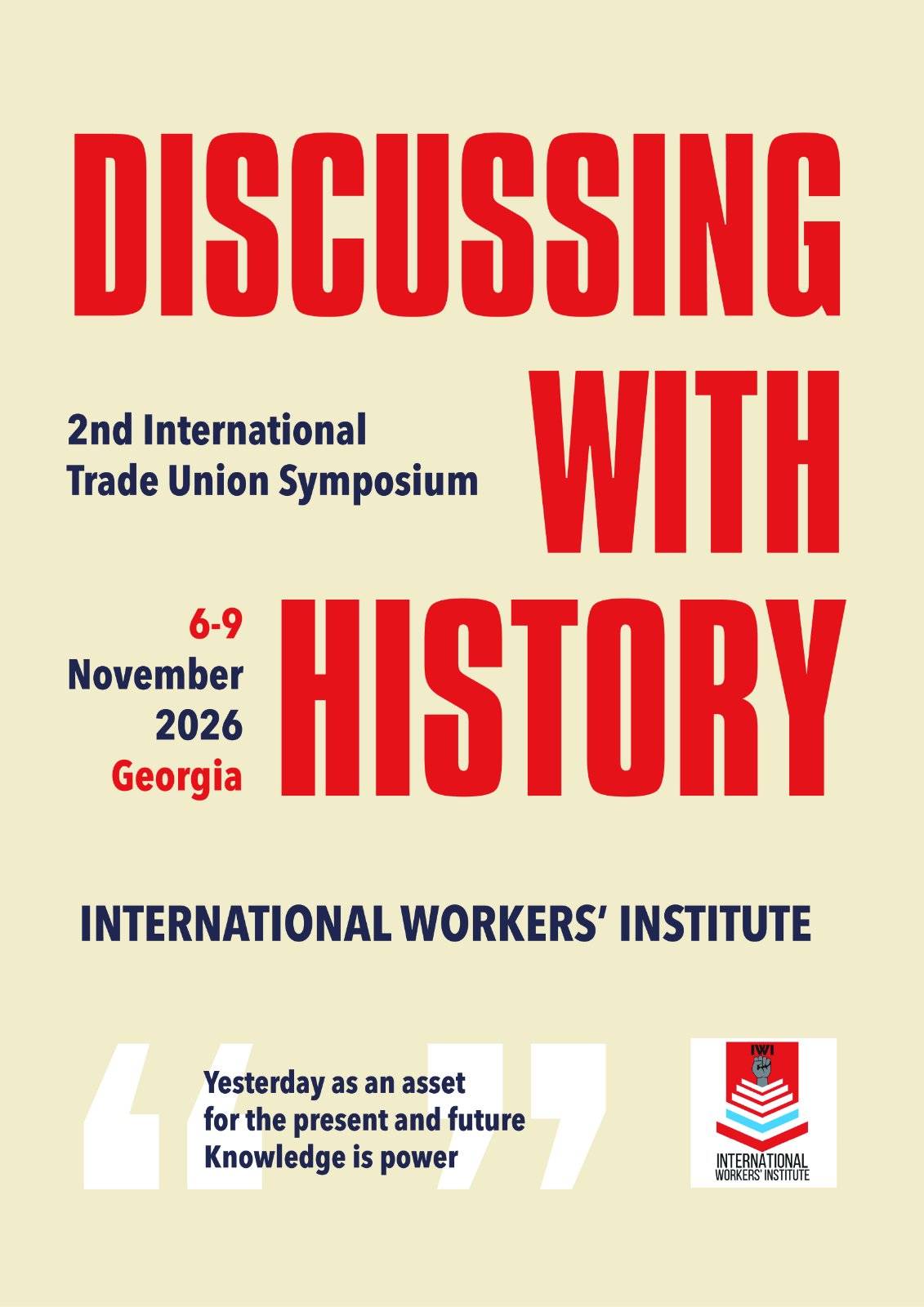

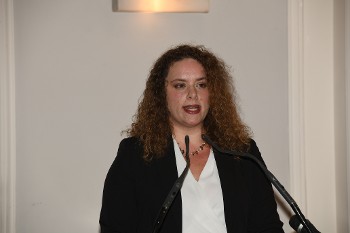
From 6 to 9 November 2026, the International Workers’ Institute held the 2nd International Trade Union Symposium in Georgia under the title “Discussing with History” and the central slogan “Yesterday as an asset for the present and future — Knowledge is power”. Fifteen speakers from Cuba, Greece, Turkey, Russia, France, Paraguay, Colombia, Argentina, Palestine, Czechia, and Kazakhstan addressed the symposium. Below, we publish the keynote speech delivered by Marina Lavranou.
A new society, a new power, a new constitution: when workers’ rights become law!
Dear colleagues,
The decision by the INTERNATIONAL WORKERS’ INSTITUTE to hold a conference on the struggle against the falsification of history could not be more timely or necessary.
Because today, more than ever, a coordinated global effort is being waged by states, governments and the media – both digital and traditional – to make the people accept, without protest, new sacrifices in terms of their income, their needs and their rights – so that the profits of large corporate groups may increase, so that military expenditure may be fuelled, and so that the war economy and preparations may be sustained.
And to this end, it also exploits the falsification of history, so that the people may submit to the myth of the common ‘national interest’ shared by exploiters and the exploited, so that they may be led like sheep to the slaughter rapidly being prepared by the rivalries and war plans of imperialist powers and alliances.
They want to conceal the true power of the working people when they decide to take matters into their own hands, to pave the way, through their organised struggle, for the overthrow of modern barbarism, the system of exploitation, poverty and wars, the capitalism.
This system, its state and those who support it, try to prevent the working people from following the path charted 110 years ago by the Bolshevik Party, when the working class and its Party proved in practice that, however all-powerful the opponent may seem, the revolutionary wave did break the ice and paved the way for a society free from the exploitation of man by man: socialism – communism!
With particular tenacity, the bourgeois leaderships persist in denigrating the first attempt at socialist construction, the USSR, and its unprecedented achievements for humanity.
No matter how much mud they sling, the facts remain indisputable. The achievements of the USSR will remain a shining beacon for workers and the popular classes, a guide to a future free from war, poverty and exploitation. And there is particular value in studying workers’ power and its state even more deeply, and of course the legal system, with the Soviet Constitution at its centre.
The study of the Soviet Constitutions helps to draw valuable and timely conclusions. Precisely because the attack on the living and working conditions of the working class and the people is intensifying, on the one hand repression is being stepped up to impose ‘cemetery-like silence’. On the other hand, the attack on the consciences and minds of the people and the youth is also intensifying , so that they may accept these new and even heavier sacrifices, and even consent to their own slaughter, even on the battlefields.
A particular aspect of this endeavour is to portray soviet society as ‘totalitarian’, illiberal and oppressive, through a barrage of slander, distortion and lies. At the forefront of this multifaceted attack is the promotion of the bourgeois ‘rule of law’, and its institutions as a supposed counterweight to totalitarianism, all within the framework of the bourgeois political system of government and the bourgeois Constitution, for its part, lies at the heart of this argument as the ‘guardian’ of society’s rights against ‘governmental arbitrariness’.
The aim is to exonerate the current system of exploitation, which shifts between forms ranging from bourgeois democracy to dictatorship, without losing sight of the ‘enemy people’. To conceal the fact that the dictatorship of capital and its state, the ‘rule of law’, has unleashed mass – pre-emptive – surveillance, censorship, extensive restrictions on political and trade union freedoms, and open violence and repression!
In these circumstances, and through the study of the Soviet constitutional texts of 1918 and 1936, the superiority of workers’ power is highlighted, and the truly active role of workers in making, monitoring and implementing decisions, despite the weaknesses inherent in this first titanic endeavour at socialist construction.
It reflects the endeavour to regulate inter-ethnic relations within the framework of workers’ power, and to resolve the ‘national question’ on the basis of the fundamental principle of proletarian internationalism, in a region where dozens of nations, ethnic groups, peoples and ethnological groups lived.
The Soviet Constitution of 1918 was born from the very heart of workers’ power, when, amidst the flames of the First World War—the ‘great director of the revolution’— at the height of the revolutionary wave of 1917 in Russia, in October, the working class, led by the Bolshevik Party, seized power.
The armed uprising marked the opening of the Second All-Russian Congress of Soviets, when, on the night of 25 October, Lenin announced from the podium that: ‘All power in the localities passes to the Soviets of workers’, ‘soldiers’ and ‘peasants’ deputies, who must ensure a truly revolutionary order’.
Within a few hours, the first revolutionary decrees on Peace and Land were passed. A workers’ and peasants’ government was formed: the Council of People’s Commissars, with Lenin as its chairman.
This is followed by two months in which the revolution triggers a ‘legislative explosion’ with the enactment of dozens of decrees organising the new society (nationalisation of banks, new institutions, an eight-hour working day, etc.), whilst the first revolutionary court was also established in Petrograd. In January 1918, the 3rd All-Russian Congress of Soviets took place and the Red Army was founded.
On July 1918, at the 5th All-Russian Congress of Soviets, the Constitution of the Russian Socialist Federative Soviet Republic (RSFSR) was adopted.
This is the first constitution in the history of humanity to have as its primary aim ‘…the complete destruction of the bourgeoisie, the elimination of the exploitation of man by man, and the establishment of socialism…’
And this is the aim of the new society!
The Constitution enshrines:
– The socialisation of land, with the abolition of private property
– The laws on workers’ control and the Supreme Council of the People’s Economy
– Universal compulsory labour ‘to eliminate the parasitic strata of society and organise the country’s economic life’, as it states.
– But also ‘… the arming of the workers, the formation of the socialist Red Army from workers and peasants, and the complete disarmament of the ruling classes’.
Free, comprehensive and universal education is established for workers and poor peasants. A poster from 1920 emphasises: ‘To have more, we must produce more. To produce more, we must know more’
Meanwhile, the nature of the new authority is clearly articulated: ‘… All power within the borders of the RSFSR belongs to the entire working population of the country, organised in the Soviets of the cities and the countryside …’
Provisions are passed concerning the Soviets and their functioning, the election of representatives who are subject to recall, and the right to vote and stand for election for the first time for both sexes, regardless of religion, nationality, etc.
And all this took place under conditions in which, as in the years that were to follow, the revolution faced the fierce reaction of the bourgeoisie and imperialist intervention by foreign capitalist states.
As Lenin emphasised: ‘The revolution – the real, radical one… is an unimaginably complex and agonising process of the withering away of the old and the birth of a new social system, a new way of life for tens of millions of people’.
Indeed, the revolution continued through the period of the civil war and ‘war communism’, followed by the NEP.
In 1922, the Union of Soviet Socialist Republics was founded, and its founding declaration would form the backbone of the first Constitution of the USSR in 1924. For 70 years, dozens of nations and peoples would live in peace.
With the policy of the ‘Offensive of Socialism’, from 1928–1929 the way was paved for industrialisation, the collectivisation of agricultural production and the elimination of the kulak class. Iliteracy was being eradicated in the USSR, the electrification of this vast country was progressing, through both the first and the second Five-Year Plans.
Meanwhile, the capitalist world was plunged into the Great Capitalist Economic Crisis, imperialist rivalries were intensifying and a new world war was being prepared, with the USSR in the imperialists’ crosshairs.
It was against this backdrop that, in 1936, the new Constitution was adopted at the 8th Congress of Soviets of the USSR. Prior to its adoption, over half a million rallies and assemblies were held within a few months, attended by 51 million people.
Any study of the Soviet constitutions and the establishment of workers’ power must focus on the fact that, as Stalin noted, ‘…This new period brings about new class realignments and an intensification of the class struggle. It demands new methods of struggle’.
In this context, the 1936 Constitution made it clear that ‘The economic basis of the USSR consists of the socialist economic system and socialist ownership of the tools and means of production…’.
At the same time, the following were specifically provided for:
– The rights and obligations of Soviet citizens, including the right to work and rest, with the statutory guarantee of a 7-hour working day, universal free access to education, healthcare, and so on.
– The duties of the central organs of power are codified: those of the Congress of Soviets, the All-Union Central Committee and its Presidium between Congresses, as well as those of the Council of People’s Commissars.
– The organisation of the Soviet judiciary is set out, with courts composed of people’s deputies, based on the fundamental principles of ‘open trials’, the right of the accused to a defence, and so on.
At the same time, and in an effort to address real-world problems, the following are introduced:
– Voting on a territorial basis and the secrecy of the ballot
– The direct election of higher bodies by the population, rather than indirect election by lower bodies
– Universal suffrage. Restrictions (on the bourgeoisie, officials of the tsarist apparatus, etc.) are lifted
The 1936 Constitution reflected the significant successes of socialist construction and the depth of the new social relations, though perhaps in an overly premature and optimistic manner.
In the face of the impending war, and due to theoretical weaknesses and an unfounded belief in the elimination of class antagonisms, amongst other things, specific problems in the functioning of the Soviets were exacerbated rather than addressed (difficulties regarding the principles of accountability, criticism, the recall of delegates, etc.).
The critical approach to these changes focuses on the need to study further the functional degradation of the production unit as the core of the organisation of workers’ power. The negative effects of this on the class composition of the higher state organs and on the application of the measure of recall (which, according to Lenin, constituted a key element of the democracy of the dictatorship of the proletariat) must be examined.
Through a painstaking and persistent effort to study and highlight the lessons learnt from the first attempt at socialist construction, we seek to shed light on the dialectical interaction between the economy and the politics of workers’ power, the interaction between the development of the forces of production and the relations of production, as reflected in the successive constitutional texts of the period 1918–1936.
Both positive and negative experience highlight the pivotal role of the subjective factor – the working class and its party – in circumstances where the new mode of production, has not yet sufficiently developed the productive forces and the new relations of production have not yet become sufficiently entrenched.
The importance of this is highlighted even more during the period of socialist construction through conscious theoretical and research work, reflected in theory, politics, legislation and the Constitution, to inspire and ‘drive’ society and the relations of production forward, against the vestiges of the old system and in favour of the emergence of the new system.
The contradictions that this process gives rise to, which take on different forms as the new society is built, can only be definitively overcome in the higher phase of communism. The policy of revolutionary workers’ power must take these contradictions seriously into account and take the necessary measures to overcome them through the expansion and deepening of communist relations of production.
The positive and negative lessons from the first ‘assault on heaven’ are a weapon in the hands of the new generation of workers, enabling us to march resolutely along the path towards the overthrow of capitalist barbarism.
The USSR, the attempt to build socialism in the 20th century, still terrifies the bourgeoisie, because it still shines a light on the truth: imperialism is not invincible; the working class can win!
And the study of Soviet constitutions offers yet another ‘window’ onto the socialist future. It highlights the superiority of the new society—the socialist-communist society—the society of true freedom, since the working class will hold power in its hands and its progressive, driving role in social development will be fully revealed.
The fact that the bourgeois state is today ‘sharpening’ its arsenal against the ‘enemy—the people’ confirms that the ruling class and its state fear the great power of the working class, the people and the youth.
When this power is multiplied through organised class struggle, no one can resist it, no one can stop it.
Thank you for your attention.
Marina Lavranou
Representative of the Militant Trade Unions of Greece