

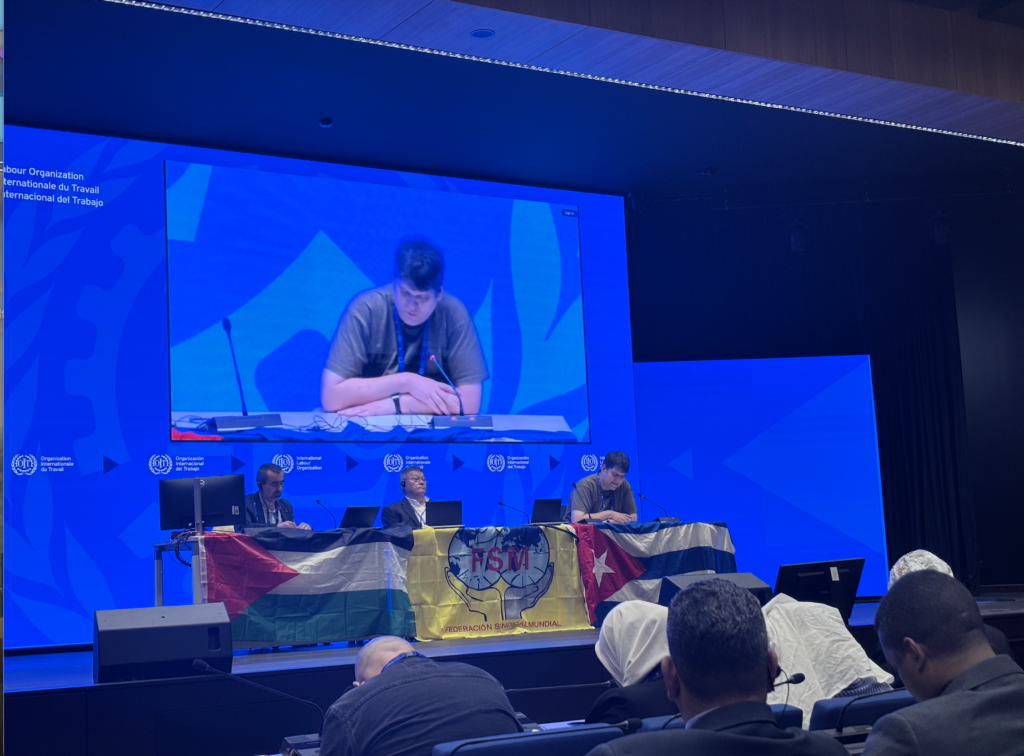
Below we share the address of c. Esteban Muñoz, representative of the International Workers’ Institute (IWI), at the joint IWI-WFTU event held within the framework of the 114th International Labour Conference on June 9 in Geneva, Switzerland.
Dear colleagues of the WFTU and its affiliated organisations, dear friends of the WFTU,
We are pleased to present this contribution, made as a member of the International Workers’ Institute, on the demand for a 35-hour working week – a necessary, mature and feasible measure. We shall begin with some introductory remarks on the history of struggles over working hours, before addressing the issue of the 35-hour week and the contemporary strategic framework.
Within the worker-popular movement, the demand for a set daily and weekly working time is a historic demand in the face of gruelling work rates that are unbearable for workers’ health. Before the mechanisation of labour, agricultural societies were entirely dependent on the variations of nature, and work was organised according to the seasons. Artisanal work in towns was regulated by trade guilds, and working hours were determined primarily by the completion of the task. Schedules were less regulated, but the work was also particularly arduous given the absence of machinery. But with technical progress and the Industrial Revolution, capital was able to develop by exploiting wage labour intensively and extensively, maximising workers’ employment to serve its own interests.
In his 1845 study on the condition of the working class in England, Friedrich Engels highlights numerous highly interesting points regarding working hours during the era of the first Industrial Revolution.
Firstly, Engels explains clearly that wage levels are closely linked to the number of hours spent at work. He gives the example that ‘a manual weaver considers himself lucky, on average, if he can earn 6 or 7 shillings a week, and even to earn this sum, he must spend 14 to 18 hours a day at his trade’.
It is indeed very important to ensure that wages are maintained when measures to reduce working hours are implemented in pilot projects or legal public policies.
Secondly, Engels notes in his study that the provisions of the 1833 English Factory Act regarding working hours differed from real industrial practices. He points out that “the law, and in particular the appointment of Inspectors, had the effect of reducing working hours to an average of 12 or 13 hours a day.” Yet, ten years later, in 1843, reports mention “that a very large number of industrialists make their workers labour for 14 or 16 hours.”
We must be extremely vigilant regarding the gap between constitutional, legal and collective agreements on the one hand, and the actual working conditions on the ground and within workplaces. To this end, we need strong trade unions and struggles that can exercise trade union rights to their fullest extent.
During this period, the emerging working class, resulting from the mass exodus from the countryside, endured unbearable working conditions. Living conditions were often unsanitary and life expectancy was very short. Engels reminds us that at that time the English working class was fighting for a 10-hour working day, amounting to a 60-hour working week over six days.
In the inaugural manifesto of the First International, Marx and Engels refer back to this demand, drawing the following lesson: “The Ten-Hour Bill was therefore not merely an important practical success; it was also the triumph of a principle; for the first time, in the open, the political economy of the bourgeoisie had been defeated by the political economy of the working class.”
We fully endorse this idea that the struggle to reduce working hours must, on the one hand, form part of a full economic programme of the worker-popular movement and, on the other hand, fundamentally affect the profits of capital. It is not a question of making the workforce more exploitable in less time. It is a question of winning, through struggle, an additional share of productivity gains for the vital needs of workers. We shall return to this.
As for the eight-hour day, it was Robert Owen who popularised this demand with the phrase eight hours work, eight hours leisure and eight hours rest. In the United States, the demand took on a national scale. On 1 May 1886, hundreds of thousands of workers took part in strikes to demand the eight-hour day.
The demand for an 8-hour day was so fundamental to the worker-popular movement that the first ILO convention concerned working hours in industry, in 1919. Article 2 stipulates that “the working hours of staff shall not exceed eight hours per day and forty-eight hours per week”.
The concept of maximum working hours is an important one because it sets a standard for all businesses and workers, although there are exceptions. It is a collective demand, not a matter of individual choice as capital seeks to impose upon us. Yet today, the buzzwords are ‘flexibilisation’ and ‘self-employment’.
It is important to note that workers’ struggles in one country have often spurred and benefited struggles in other countries, just as the Ten-Hour Bill in England benefited workers in other industrialised countries in Europe, and just as the gains on working hours in the Soviet Union benefited workers worldwide.
Today, the global situation is far from uniform when it comes to working hours. Capital is waging a fierce offensive against workers’ rights regarding wages and social security, freedom of association and collective bargaining, as well as everything relating to working time: working hours, holidays and the retirement age.
We must therefore approach the demand for a 35-hour week from a strategic perspective, that is to say by conducting a very thorough analysis of the balance of power between capital and labour, the bourgeois criteria of capitalist governance in labour law reforms, and the concrete practices of employers in the exploitation of staff and the organisation of work.
Technological progress, as well as the increasing skills of workers—that is, their expertise—which essentially constitute the productivity gains of capital, present an opportunity to reduce the weekly working hours. But, dear colleague, the worker-popular movement must win its rights through its own struggles, by strengthening class-based, independent and militant trade union organisations.
The class-based trade union movement must argue for a reduction in working hours on the basis of the benefits to the working class itself, and we must take this on board as such. We cannot adopt the capitalists’ arguments on this issue as our own, saying, for example, that workers would be more easily exploited in less time. The demand for a 35-hour week must be won by the workers and for the workers.
Ultimately, the demand for a 35-hour week is also a wage demand, as it is the period over which wages are determined. Wages must be maintained when working hours are reduced. This necessarily implies defending the principle of wages, as there are a multitude of ways in which capitalists seek to lower wages. In the event of inflation, wage laws must provide for indexation to automatically compensate workers for their loss of earnings, based on independent statistics and taking into account workers’ basic needs. If this is not the case and the reduction in working hours takes place over several years, this gives capital the means to take advantage of the situation by lowering wages as well.
The class-based trade union movement must fight against the principle of flexibilisation so dear to capitalist employers, who, in its name, are dismantling all universal workers’ rights. The 35-hour working week must be a maximum applicable to all employment contracts, regardless of their status, whether formal or informal. The statutory working week cannot merely be an optional guideline. It must be possible to monitor compliance and enforce it. Furthermore, beyond this limit, overtime must be paid at a premium and always with the workers’ consent.
To this end, we also need strong class-based trade unions, and we must strengthen the World Federation of Trade Unions in this regard with a robust action plan for trade union struggles, to ensure that our demands—such as the 35-hour week and the conditions under which we wish to implement them—are known to workers.
We must also be very wary of the logic of trade-offs, that is to say, ‘I give on one side and take on the other’. The class-based trade union movement must have its own political economy to confront the political economy of the bourgeoisie, so that a partial advance is a real advance.
In conclusion, the demand for a 35-hour working week – a necessary, mature and feasible measure – must be complemented by a full economic programme that guarantees the maintenance of wages, with indexation against inflation, and the establishment of a maximum working week, applicable to all employment contracts and subject to strengthened oversight by class-based trade union organisations.