
International Workers’ Institute (IWI)
KNOWLEDGE IS POWER
Three-Year Report 2022–2025 – Planning 2026–2029
Three years of theory and praxis helping and supporting trade union organizations, trade unionists, and young workers.
Introduction
The International Workers’ Institute (IWI) constitutes a substantial and mature initiative of recent years. The present Action Report evaluates the three-year trajectory of the IWI, systematically records its basic activities, and attempts a global evaluation of its contribution.
1. The reasons for the founding – Need – Basic Objectives
The IWI was not created as another “think tank.” It was created as a “mature child of necessity”; a necessity that was born with the objective of:
- Placing at the center of attention of the trade union movement the Marxist vision of social classes and the tasks that derive from it for militants in the contemporary era.
- Arming trade unionists with scientific tools and the method of Marxist analysis.
- Highlighting the unity of theory and practice in everyday life.
- Contributing to the regrouping of the class-oriented trade union movement at sectoral, regional, national, and international level.
- Supporting trade union education and trade union training on contemporary theoretical issues and with special attention to younger generations.
- Making its presence visible in international bodies.
Thus, in this direction, a group of experienced trade union cadres, scientists, and experts from 13 countries on the 5 continents founded in May 2022 the International Workers’ Institute (IWI).
The first founding Trade Union Educational Committee (TUEC) of the IWI was composed of:
- Belarus – Vladimir Pozdniakov: Rector of the International University “MITSO.” Vice President of the Federation of Trade Unions of Belarus (FTUB).
- Colombia – Édgar Marcote: Member of the Presidential Council of the WFTU, founding member of the National Secretariat of WFTU Colombia and of its Trade Union Education School.
- Cuba – Dania Leyva Creagh: Researcher at the Institute of Philosophy of Havana, member of the National Secretariat of Workers of Education, Science and Sports of the CTC.
- DR Congo – Vincent Kapenga Kandolo: Member of the WFTU Secretariat, National Secretary of the CTP of the DR Congo and worker at the National Railway Company of Congo (SNCC).
- France – Axel Persson: General Secretary of the CGT Railway Workers’ Union in the city of Trappes. He has been a member of the WFTU World Working Youth Committee.
- Greece – George Mavrikos: Honorary President and former General Secretary of the WFTU (2005–2022). Former General Secretary of the Greek GSEE (1993–1998) and for ten years President of the Trade Union History Archive (AR.ISTO.S) of the same organization.
- India – A. R. Sindhu: National Secretary of the Centre of Indian Trade Unions (CITU) and General Secretary of the All India Federation of Anganwadi Workers and Helpers (AIFAWH), a sectoral federation of workers in the field of primary health care with 500,000 members. Coordinator of the Pan-Indian Working Women’s Coordinating Committee, the women’s committee of CITU founded in 1979.
- India – H. Mahadevan: Historic cadre of AITUC of India and for years member of the Secretariat and Deputy General Secretary of the WFTU.
- Italy – Cinzia Dellaporta: Head of International Relations of USB Italy, Member of the WFTU Secretariat and Coordinator of the WFTU World Working Women’s Committee.
- Palestine – Suzan Tayseer Abdel Salam: Social worker, Member of the Presidential Council of the WFTU, President of the Palestinian National Unions / Jerusalem (JNUPW). Deputy Mayor of Bir Nabala (2022–2026) and President of the Northwest Jerusalem Women’s Union.
- Peru – Valentín Pacho Quispe: Former Vice President of the WFTU, former General Secretary of the General Confederation of Workers of Peru (CGTP) and former Senator of Peru.
- South Africa – Zola Saphetha: General Secretary of the National Education, Health and Allied Workers’ Union (NEHAWU). General Secretary of the International Union of Public Services (UIS Public Services).
- Spain – Luis Miguel Busto: Member of the Presidential Council of the WFTU and of the leadership of the International Union of Transport, Ports, Fisheries and Communications (UIS Transport). In 2019 he was elected president of the ASC union at Spanish Telefónica.
- USA – Chris Townsend: Representative of United Electrical Workers (UE) in Washington and organizing director of the international federation of the Amalgamated Transit Union (ATU).
- USA – Walter Tillow: Veteran trade unionist from Kentucky and member of the coordinating team of the WFTU in North America.
- Greece – Anda Anastasaki: Executive Secretary of the WFTU and Member of the Leadership of the International Union of Pensioners and Retirees (UIS P&R).
2. The character of the three-year action
The action of the IWI from the very first moment had a clear orientation:
- No neutral or colorless knowledge, but knowledge committed to the working class.
Theory is not treated as an end in itself, but as a tool:
- For understanding modern forms of exploitation.
- For unmasking the mechanisms of co-optation of working-class sectors.
- For elaborating directions of struggle.
The educational activity of the IWI was organized mainly through international virtual seminars, theoretical seminars, online symposia and presentations, while the first International Theoretical Trade Union Symposium was also held. Actions that allowed the participation of trade unionists from dozens of countries.
3. Detailed presentation of the virtual seminars and the basic themes
3.1 The First Trade Union Training Cycle
- “The role of NGOs and the stance of militant trade unions” | 31/10/2022
This Seminar inaugurated on 31/10/2022 the First Trade Union Training Cycle aimed at grassroots trade unionists, trade union cadres, and social militants.
Its main speaker was the historic cadre of the world trade union movement Valentín Pacho. More than 45 cadres from countries around the world participated in the seminar: trade unionists, experts, and scientists.
The presentation focused on NGOs as the long arm of multinationals and imperialism, as well as a tool of contemporary colonization with a “trade union” cloak. Comrades from India, Haiti, Colombia, the USA, Portugal, Mexico, Morocco, and South Africa contributed experiences from their countries. A special reference to the corrosive function of NGOs on workers’ consciousness in South Africa was made in the closing by Mike Mzwandile Makwayiba, President of the WFTU.
- “The NATO–Russia War and the Food Crisis” | 28/11/2022
The second online seminar of the IWI focused on geopolitical developments and their immediate consequences on the living conditions of the working class. Main speaker was the Congolese trade unionist Vincent Kapenga Kandolo. As stated by the IWI within the framework of the seminar:
“The imperialists and war create serious food problems for the peoples of Africa and of the whole world. The dirty role of NATO, in addition to dead soldiers and civilians, causes hunger at the international level. It causes high cost of living, layoffs, and poverty.”
More than 57 cadres, trade unionists, experts, scientists, etc. from more than 27 countries participated in the seminar.
iii. “The historic treacherous role of social democracy against the revolutionary struggle of workers” | 22/12/2022
The third consecutive educational seminar of the IWI focused on history as a tool of struggle of the working class, with the “living memory” of our class educating, warning, and teaching. Main speaker was Kostas Borbotis, Greek political scientist and research collaborator of PAME (Greece). The Seminar was followed by 95 trade union cadres from 35 countries worldwide. In the conclusions of the Seminar it was mentioned:
“Throughout the historical trajectory of the workers’ movement we will find two lines: the line of class struggle and the line of class collaboration. In the various events, in the various historical phases, again and again we will find these two lines in constant confrontation.”
- “Conclusions from cases of corruption of leaders of yellow trade unions in the European Union” | 19/1/2023
The scandal already known as “Qatargate,” concerning the covering up of workplace deaths at the construction sites of the Football World Cup in Qatar by yellow trade union leaders, and specifically the General Secretary of the ITUC, Luca Visentini, provided the occasion to continue the discussion on reformism that had begun in the previous seminar.
Main speaker was the Italian trade unionist Pierpaolo Leonardi, Coordinator of the European Office of the WFTU. Interventions were also made by Quim Boix, General Secretary of the UIS Pensioners and Retirees, and Markos Bekrís, President of the Departmental Union of Piraeus. As also underlined in the main presentation regarding the ITUC/ETUC:
“[…] they cannot even be called trade union organizations; they are simply a useful mechanism in the EU apparatus, an organ of the EU’s capitalist war against the working class.”
- “The Role of International Organizations Today” | 6/3/2023
The sharpening of imperialist antagonisms and the catastrophic consequences for peoples could not be left out of the critical-educational view of the IWI regarding the role of International Organizations today. The 5th consecutive seminar closed the 1st Trade Union Training Cycle and took place on 6/3/2023.
The veteran Indian trade unionist H. Mahadevan, with years of experience in international bodies such as the ILO, FAO, UN and UNESCO, in his presentation shared with trade unionists from all over the world useful aspects of the character of International Organizations in an environment of negative international correlation of forces for the world working class. Characteristically he pointed out:
“The struggle and interventions in international organizations are not sufficient if they are not combined with trade union struggle in each country, so that the correlation changes in favor of the workers, first and mainly at the national level.”
- Joint IWI and CTC Trade Union Symposium
“Fidel Castro and the International Working Class” | 8/2/2023
A special moment in this period was the Trade Union Symposium “Fidel Castro and the International Working Class,” which was co-organized by the Institute and the Cuban CTC.
The choice of the date was not accidental, as it combined both the founding date of the CTC on January 28, 1939, and the date of the funeral honors of Commander Fidel Castro Ruz. The central presentations at the Symposium were made by Dania Leyva Creagh, researcher at the Institute of Philosophy of Cuba, and Ulises Guilarte de Nacimiento, General Secretary of the CTC.
The proceedings were broadcast by Cuban television and more than 95 trade union leaders from 37 countries of all continents participated, with 25 speakers taking the floor and referring to the special internationalist legacy and Fidel’s connection with the trade union movement of their respective country. As mentioned by the President of the Institute, G. Mavrikos, in the opening of the proceedings:
“Such was Fidel. A revolutionary of action. An internationalist of action. Unyielding, visionary, with faith in the inexhaustible forces of the working class and of the popular masses.”
3.2 Theory and Practice for the Ideological Emancipation of the Working Class
On June 8, 2023, the TUEC met and collectively decided, based on proposals from friends and members of the IWI from all over the world, both on its immediate action and tasks, as well as on the 2nd Trade Union Training Cycle, with new content and rich initiatives. At the same time, the IWI dynamically began its participation in a series of international forums and spaces, promoting the class-oriented ideological counterattack. Specifically:
- On 13/6/2023, the President of the IWI, George Mavrikos, was invited to the WFTU initiative for the 111th ILC (International Labour Conference), delivering a speech in Geneva with the title: “The current priorities of the working-class movement and the role of the ILO.”
- On 16/6/2023, the President of the IWI delivered a speech at the Pan-European Conference of the UIS Pensioners and Retirees in Monaco, underlining the need for the experience of veterans of the class struggle to be linked with practical trade union education.
- From 20 to 22/9/2023, Luis Miguel Busto Mauleón, member of the TUTC, visited Colombia, where he participated in a special trade union training program of the WFTU Colombia school. More than 65 young trade unionists took part in the seminar days, with a strong presence of women trade unionists.
The events of October 7, 2023, with the murderer-state of Israel initiating its genocidal attack against the heroic Palestinian people in Gaza, shocked the world working class. The IWI immediately organized an International Trade Union Conference in solidarity with Palestine, with 52 cadres from 24 countries of all continents on November 11, 2023.
The main speakers were Cinzia Della Porta, Head of International Relations of USB Italy and member of the TUTC, Marwan Toubassi, former Ambassador of Palestine in Athens, as well as the Palestinian trade unionists Suzan Abdel-Salam, member of the TUTC, and Hussein Karabsa.
A complete picture of the Palestinian struggle was presented, of the criminal role of the EU, of all European governments, of the USA and its allies that support the genocide taking place in Gaza with the aim of the expulsion of the Palestinians and the creation of the conditions for “Greater Israel.”
The participants who took the floor expressed their commitment to continue internationalist support in all possible forms.
3.3 The Second Trade Union Education Cycle
- “Religions and the Trade Union Movement” | 30/1/2024
The international virtual seminar on “Religions and the trade union movement” constituted a crucial intervention that inaugurated the Second Trade Union Training Cycle. The central presentation was delivered by Axel Persson, member of the TUTC and Secretary of the CGT Railway Workers’ Union in Trappes.
There it was highlighted that religious differentiation is often used as a “tool for the division of the working class,” but also that workers, regardless of their personal beliefs, have a common class interest.
The discussion focused on the role of ideological mechanisms, on the need for class unity, and on the dividing line between personal faith and collective class action. The participation of trade unionists from approximately 30 countries demonstrated the international importance of the issue.
- “The role of the working woman in the International Class-Oriented Trade Union Movement” | 8/3/2024
The IWI chose to dedicate the second seminar to the working woman and to hold it on March 8, International Working Women’s Day. Main speakers were Dania Leyva Creagh, member of the TUTC and researcher at the Institute of Philosophy in Havana, Cuba, as well as Cinzia Della Porta, member of the TUTC and of the WFTU Secretariat.
More than 45 international participants, women trade union leaders from all corners of the world, honored this combative anniversary. As emphasized in the speeches:
“The solution and the way out are found in the common struggles of women and men against the social system that creates the exploitation of man by man.”
iii. “Historical Lessons of the USSR for the contemporary militant trade union movement” | 9/5/2024
On May 9, 2024, on the 79th anniversary of the Great Anti-Fascist Victory, the IWI carried out the third seminar of the second trade union training cycle on the ZOOM platform with the title: “Historical lessons of the USSR for the contemporary militant trade union movement.”
More than 54 trade union leaders and fighters from 29 countries worldwide participated in this international digital event, highlighting the historical legacy of the first workers’ state in the world for the contemporary trade union movement.
Comrade Edgar Marcote from Colombia, member of the TUTC of the IWI and member of the Presidential Council of the WFTU, delivered the main speech. In addition, 31 comrades of the WFTU in Colombia participated in person in the conference hall. Special interventions were also made by: Pambis Kyritsis, General Secretary of the WFTU, Vasilis Opsimos from the Marxist Research Center in Greece, Evgeniy Kulikov, General Secretary of the SPR of Russia and member of the Presidential Council of the WFTU, Valentín Pacho, member of the TUTC, and Quim Boix, General Secretary of the UIS Pensioners and Retirees.
- “Artificial Intelligence and the Trade Union Movement” | 10/12/2024
The Second Trade Union Training Cycle closed with the seminar on “Artificial Intelligence,” which highlighted the capacity of the IWI to address modern phenomena with class criteria.
More than 90 trade unionists from 35 countries participated in the seminar. The central presentation was delivered by Grigoris Lionis, PhD Mechanical Engineer. An intervention was also delivered by Sudip Dutta of CITU India and expert in nanotechnology, with the topic “Artificial Intelligence: Utopia or Dystopia?”
In the interventions, technology was not presented as neutral, but as a tool of intensification of exploitation, a mechanism of control and intensification, as well as a field of new class conflicts.
At the same time, the task of trade unions to understand developments was posed, so as not to be caught unprepared but to organize conscious resistance.
3.4 Additional Actions of the Period
- Meeting of the Eurasian Office of the IWI | 20/10/2024
The working meeting of the IWI took place in Istanbul, Turkey, with the presence of the President of the IWI, George Mavrikos, and specialized trade unionists and scientists from Eurasia (Turkey, Iran, Kazakhstan, and Russia), with the objective of developing trade union education based on the principles of class struggle, the struggle against imperialism, and social exploitation.
The need to found the Eurasian Office of the IWI was underlined.
- Joint Digital Seminar IWI–WFTU entitled: “Women: Struggles, Resistance and War” | 29/11/2024
The initiative was co-organized by the WFTU and the IWI, while the Central Speeches were delivered by Dania Leyva Creagh and Suzan Abdel Salam, members of the TUTC.
The initiative concluded by underlining:
“Today, the urgent need to combat the genocide committed by the Israeli Zionist army requires us to concentrate our forces alongside Palestine, for the confirmation of its right to a sovereign, democratic, and independent state.”
3.5. Third Trade Union Training Cycle
Moving on to new themes, but with important extensions for the life and struggles of the working class, the Third Trade Union Training Cycle included the following basic digital seminars:
- “The tariffs imposed by the USA and the consequences for workers and the peoples of the world” | 30/5/2025
Main speaker of the seminar was the South African trade unionist Zola Saphetha, leader of NEHAWU, General Secretary of the UIS Public Services of the WFTU and member of the TUTC.
Participation exceeded 60 trade unionists from 35 countries. Characteristically, it was mentioned in the presentation:
“History repeats itself in the case of Trump’s tariffs. The imperialist powers rise and fall continuously, none has guaranteed permanent economic advantage or supremacy, and history is in the process of repeating itself. The American empire remains the most powerful, but it is in decline.”
- Presentation of the book “Blue-Collar Empire” by J. Schuhrke | 24/6/2025
The online presentation of the book by the distinguished scientist J. Schuhrke from the USA, Labor Historian and Assistant Professor at the Harry Van Arsdale Jr. School of Labor Studies of SUNY Empire State University, constituted a historical and political intervention.
It highlighted the role of US-style AFL-CIO trade unionism as a mechanism of anti-communism and imperialist influence. The discussion helped:
- To the understanding of historical experiences.
- To the demystification of “strong” trade union centers.
- To the drawing of a dividing line between class-oriented and employer-oriented trade unionism.
More than 50 trade unionists and cadres from 22 countries participated in the event, a fact that reflects the broad international interest in this critical historical period.
3.6. Additional Actions of the Period
- On 5–6/4/2025, Alexandra Liberi, Head of Communication of the IWI, represented the Institute at the World Congress of FISE, in Rabat, Morocco.
- On 15/5/2025, Dania Leyva Creagh, member of the TUTC, participated in the seminar entitled: “Content of global geopolitical globalization and its impact on the working class,” which was held in San José, Costa Rica, organized by UNDECA, the Institute of Philosophy of Havana, and the IWI.
- On 11/6/2025, at the 113th ILC in Geneva, Anda Anastasaki, member of the TUTC, delivered a speech during an event organized by the WFTU with the theme: “Democratization of the ILO.”
- On 24/8/2025, Luis Miguel Busto, member of the TUTC, participated in the digital discussion organized by STINOVES (El Salvador) with the theme: “The role of the proletarian press and propaganda work in the class struggle,” held within the framework of the 15th anniversary of the newspaper “La Chispa Obrera.”
- On 3/10/2025, the President of the IWI, George Mavrikos, addressed the Central Event of the WFTU for its 80 years in Paris, France. The title of his speech-article: “We come from very far away and we go very far into the future, with the objective of the abolition of exploitation.”
- On 11/10/2025, in Bogotá, Colombia, the 3-member working committee of IWI Colombia was founded, composed of Edgar Marcote, Jorge Gamboa, and Ernesto Mora.
3.7. Working women and trade union struggle
In the webinars of the IWI, the importance of the rights of working women and of their participation in the international trade union movement was highlighted. Emphasis was placed on the multiple forms of exploitation they face, such as lower wages, precarious labor relations, and greater exposure to gender-based violence, as well as the need to combine class and gender consciousness for the strengthening of the class struggle and international solidarity.
3.8. Imperialist interventions and Palestine
An important place was occupied by imperialist interventions, with emphasis on the Palestinian issue, as an expression of the structural barbarism of capitalism. Wars, occupations, and economic blockades strike the working class directly, pointing to the need for internationalist solidarity and coordinated class resistance.
3.9. USSR and History of the Working Class
The historical analysis of the USSR highlighted the achievements of socialism and the possibility of collective power and social rights, while at the same time the examination of its contradictions offered valuable conclusions for modern class strategy and the confrontation with the ideological hegemony of capital. 4. International scope and organizational dimension
In its three years of action, in the IWI:
- More than 800 trade unionists have participated.
- From more than 90 countries.
- With participation of organizations, trade unions, and scientific entities.
This international dimension is not a quantitative element. It is a qualitative characteristic that reinforces proletarian internationalism and the awareness that the struggle is common.
4.1 International Articles from the point of view of the working class
On the website theoryandpraxis.eu, articles were published by trade unionists from different countries and sectors, which highlighted a wide spectrum of critical issues of the modern class struggle, connecting theoretical analysis with the living experience of workplaces.
Among the topics developed are modern forms of exploitation and flexible work, attacks on trade union rights, the role of “yellow” trade unions and social corporatism, imperialist wars and their consequences, a class perspective from Venezuela, the privatization of basic social goods, repression of trade union action, as well as historical experiences of workers’ struggles.
These articles served as a space for collective elaboration and internationalist exchange of experience, reinforcing the theoretical equipment and orientation of the class-oriented trade union movement.
4.2 Printing and Presentation of the WFTU History Book in various countries
The book presentations by comrade G. Mavrikos in several countries, such as India, Italy, Spain, Chile, Peru, Paraguay, with the important contribution of militants and trade unions in these countries, constituted an important aspect of the IWI’s international action, reinforcing its role as a living center of theoretical and political intervention.
Through these events, the analyses and conclusions developed by the IWI came into direct contact with trade unionists, workers, and activists from different countries, connecting with the concrete conditions and struggles in each place.
The presentations contributed to the dissemination of class awareness for the trade union movement, to revealing the role of reformism and employer-oriented trade unionism, the great history of struggles of the class-oriented trade union movement, as well as to strengthening proletarian internationalism, functioning not simply as book promotion, but as substantial moments of political education, exchange of experience, and consolidation of the IWI’s presence and credibility in the international class-oriented trade union movement.
The book currently exists in English, French, Spanish, Arabic, Tamil, and soon in Turkish.
4.3 First International Theoretical Trade Union Symposium
The 1st International Trade Union Symposium on the theme:
“The Characteristics of the Working Class in Our Time”
was held on November 7–8, 2025, in Athens, Greece, with rich and current theoretical themes.
A total of 19 countries participated, with speakers from Greece, Vietnam, India, Cyprus, Colombia, Turkey, Czech Republic, Palestine, Italy, Chile, France, South Africa, Cuba, Spain, Germany, USA, Romania, Sweden, and Lebanon, as well as the General Secretary of the WFTU.
All speeches will be published in an edition of the International Workers’ Institute, gathering all the interventions and constituting an important resource for the present and future of militants of the class-oriented trade union movement.
5. Digital media and living struggle – without illusions
The IWI utilized digital media as a tool, not as a substitute. The experience of webinars confirms that:
- They can break geographic and temporal barriers.
- They can expand the discussion, but do not replace the need for deeper engagement, for greater transfer of experience from top to bottom and bottom to top, for study and expansion of initiatives that arise spontaneously and from living action in workplaces.
The IWI has its own network in dozens of countries with committees and initiative groups. It has presence in 90 countries with trade unions and other scientific and theoretical entities.
Conclusions
In general, we evaluate the functioning and action of the IWI positively.
- It connected trade unions and trade unionists with immortal Marxist theory.
- It opened the discussion on current and urgent topics that require continuous study and deepening.
- It supported younger generations of trade unionists through its educational programs.
- It highlighted the need for international coordination and internationalist solidarity.
- It operated openly, democratically, and broadly without exclusions.
Unfortunately, due to the non-existent economic resources of the IWI, we could not respond to requests from primarily African trade unions, but also others, for organizing trade union programs in their countries.
Finally, we note that this rich three-year action now places us before new tasks, greater responsibilities, and new challenges.
PROGRAM 2026–2029
Strengthening organizational presence of the IWI in regions and continents.
After the founding of the Eurasian office, opening to other continents is also planned, with the first step being the establishment of committees in even more countries and sectors, with care for active functioning and regional initiatives.
Collaborations with corresponding institutes
From trade union organizations and other corresponding agencies and educational entities:
- SOUTH AFRICA: Chris Hani: It is an institute operating under the responsibility of COSATU. We met and agreed on joint activities for the African continent.
- CUBA–CTC: Lázaro Peña: Has a rich trade union educational action for all of South America, the Caribbean, and Central America. In coordination with the CTC, we are preparing to announce an important joint international initiative.
- Institute of Philosophy
- CHINA–ACFTU: We scheduled a visit of an IWI delegation to the People’s Republic of China to discuss current trade union issues with institutes of the National Federation of Trade Unions of China.
- China University of Labor Relations (CULR–ACFTU)
- Vietnam: Institute for Workers and Trade Unions (IWTU–VGCL)
- Greece: “Charilaos Florakis” Educational Center
- Iran: KarHigherEducationInstitute
- Italy: Centro Studi Trasformazioni Economico-Sociali (CESTES–USB)
- India:
- EMS Academy (Kerala)
- Joshi–Adhikari Institute of Social Studies
- Mexico:
- Vicente Lombardo Toledano Center for Philosophical, Political, and Social Studies
- Universidad Michoacana de San Nicolás de Hidalgo
- Peru: CGTP National School of Trade Union Training
- Chile: Clotario Blest Trade Union Training School
- Cyprus: PEO Educational Institute
- ILO–UNESCO: We are also in contact and discussion with the ILO and UNESCO and have submitted texts with specific themes of trade union interest and more general topics.
- WFTU Pensioners’ UIS: In collaboration with the UIS leadership but also with member unions such as the Federation of Pensioners of Greece, pensioners’ unions of Morocco, Spain, etc., planning exists to leverage accumulated historical trade union experience.
We declare ourselves open and ready to communicate with corresponding institutes and educational institutions for the development of joint initiatives on all continents on contemporary and commonly relevant topics.
7/8 NOVEMBER 2026 | 2nd International Theoretical Trade Union Symposium
We propose that the Triennial General Assembly decide to carry out this Symposium with the theme:
“Defense of historical truth – Defense of the history of the trade union movement.”
We live in a period where attempts are made to rewrite history and revise historical truth.
The militant trade union movement has great historical milestones of heroism and class struggle, and we must disseminate them to younger generations as lessons for the struggles of the present and future.
Because to know where we are going, we must not forget where we come from.
Trade unionists, scientists, historians, expert scholars, and researchers will be invited.
We are not yet ready to propose a country to host this international initiative.
SEMINARS – CONFERENCES – FORUMS
A
- The “Jungle” of International Law. The aspirations of the USA and its allies [Gaza – Venezuela – Greenland – Iran – Taiwan, etc.]
- South–North–East–West
- Multipolar world – unipolar
- Blockades – Embargoes – Tariffs
- Capitalism – Socialism
- Simple lessons of Political Economy
B
- The strength of the Peoples and of workers
- The strength of law and the law of the strongest
- What type of trade union movements does our era need?
- AI (Artificial Intelligence) and militant trade unions
- The creation of social classes – social struggles
- Why is the working class the vanguard social class?
C
- The battle of history and historical truth
- The history of the International Trade Union Movement and the WFTU
- Knowledge of trade union history of countries and economic sectors
- Important trade union struggles of the world working class
- Commemorative events for important trade union leaders
- Internationalism – solidarity, immortal weapon of the popular movement
- Cultural history and social awareness
D
- Seminars already programmed by the Executive Committee but also with open willingness for proposals from trade union organizations on topics that interest them
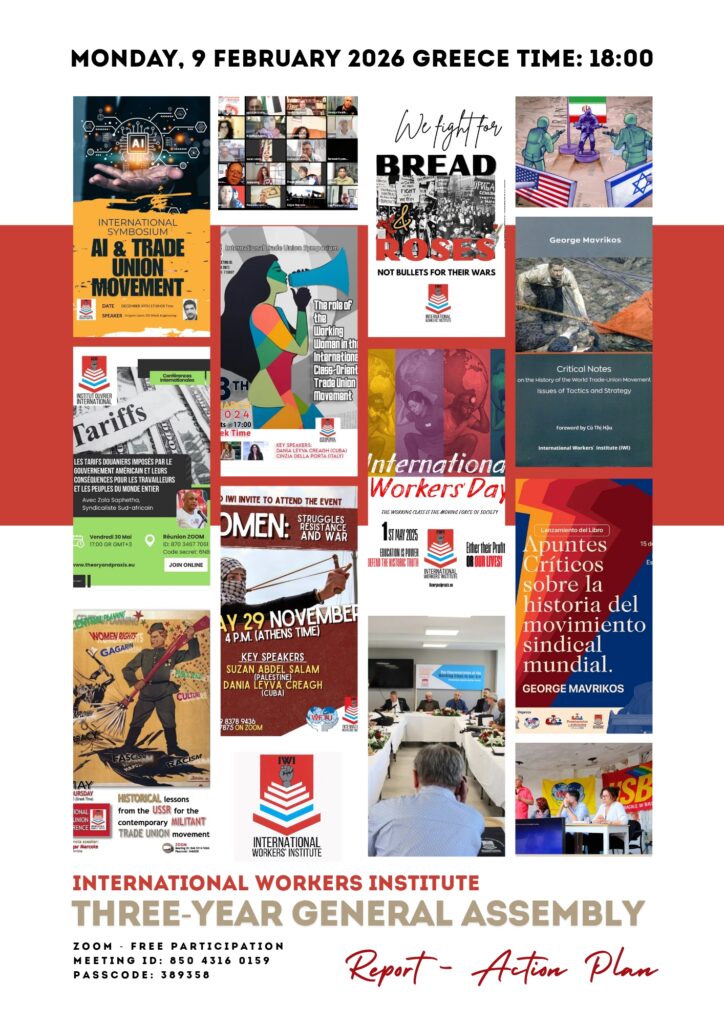
Triennial General Assembly
- Monday, 9 February 2026