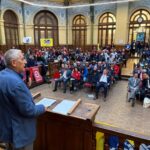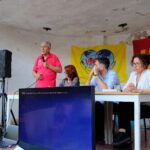


SWAZILAND PUDEMO LABOUR SCHOOL — OCTOBER 9th, 2025 hosted by NUM South Africa
Presentation: Alexandra Liberi, International Workers Institute (IWI) – Head of Public Relations
Theme: Imperialist Capitalism, War Aggressiveness, and the International Working-Class Struggle. The Role of the International Workers Institute in the Ideological War
Download file here
Introduction: The Department of War
“Good morning, and welcome to the War Department, because the Department of Defense is over.”
This was the opening line of Secretary of War Pete Hegseth’s recent address in Quantico to the U.S. military’s senior leadership.
We all know that the U.S. government, since its very foundation, has never been about defense — but about colonial conquest, from the slaughter of Native Americans to its imperial domination of the globe. It has slaughtered people in Vietnam, in Korea, in Yugoslavia, in Afghanistan, in Iraq, and interfered to internal affairs around the world with organized coups, CIA backed dictatorships in South America, in Greece and Portugal, in South Asia, or lately by steering the poor popular strata into the arms of the puppets of the US or allied imperialist domination as it is doing now in Nepal and have done in Libya, in Syria, in Egypt or wants to do in Iran, in Lebanon, in Venezuela and everywhere. Yet, the rebranding of the Department of Defense into the Department of War marks a new escalation in U.S. aggression.
This was not a cosmetic change. The U.S. didn’t spend millions just to rename a department while the U.S. and Israel are committing genocide against the Palestinian people in full view of the world and are increasing their threats against the people of Venezuela. The name change is a signal — to the world and to its own people — that everyone should “be ready for everything.”
When the leaders speak of peace,
The common folk know that war is coming.
When the leaders curse war,
The mobilization order is already written out.
Their war kills whatever their peace has left over.
Poem by Bertolt Brecht
Capitalism, Fascism, and Modern Slavery
Trump’s tax cuts — trillions handed to the capitalist class — gutted healthcare, food aid, and education while exploding national debt. $170 billion was allocated to “immigration enforcement.” In reality, this meant putting migrant workers in private, profit-driven prisons, forced to work for $1 a day. Detention of migrants under ICE contracts remains one of their most stable profit streams, especially as average daily ICE detainee counts rose above 35,000–40,000 in FY2024.
| Company | Revenue (2025) | Key Role |
|---|---|---|
| GEO Group | $636.2 million (Q2 2025) | Operates 124 U.S. detention centers |
| Core Civic | $488.6 million (Q1 2025) | Manages 108 detention facilities |
As Georgi Dimitrov wrote 90 years ago:
“The accession to power of fascism is not an ordinary succession of one bourgeois government by another,
but a substitution of one State form of bourgeois class domination — bourgeois democracy — with another — open terrorist dictatorship”.
Europe’s Return to Militarism
Germany, disarmed after the defeat of the Nazi’s by the Red Army in 1945, is now one of Europe’s largest arms exporters. Civilian industries are being converted into military production lines. Rheinmetall and Airbus profit from war while the state justifies this “rearmament” as job creation and “safety.”
This echoes the same rhetoric that once brought Hitler to power.
| EU Program | Budget | Description |
|---|---|---|
| ReArm Europe | €800 billion | Public funds redirected into the military-industrial complex |
| SAFE | €150 billion | War securitized as an “investment opportunity” |
NATO now plans to raise military spending from 2% to 5% of GDP — robbing funds from healthcare, housing, and education to enrich arms corporations, while crippling already devastated national economies.
NATO, Global Bases & other global and regional alliances
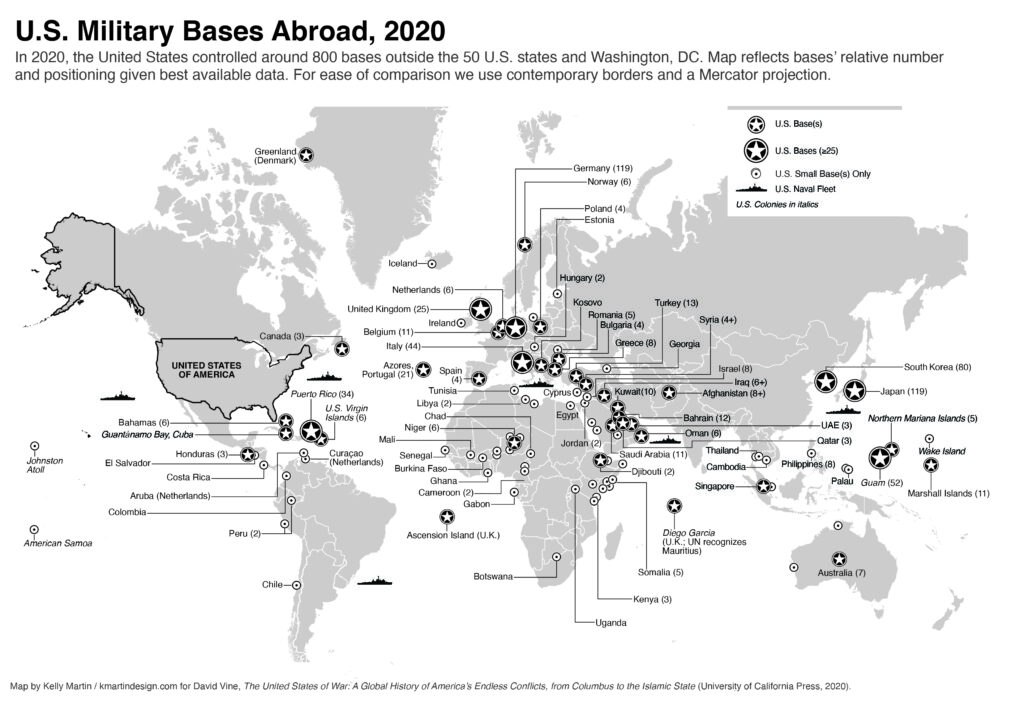
After WWII, NATO was founded in 1949. Today, the U.S. maintains nearly 800 foreign bases in over 70 countries.
| Country | U.S. Base Presence | Strategic Purpose |
|---|---|---|
| Switzerland | None | Financial neutrality |
| China | None | Target of containment |
| Cuba | None (except Guantánamo) | Target of embargo |
| Venezuela | None | Target of sanctions and war threats |
This global web of bases and sanctions has fueled wars from Ukraine to the Middle East, between populations who until a few decades ago were coexisting peacefully. The war of tariffs aimed mainly from US against Russia or Iran, with threats even against India, as well as the 63year embargo on Cuba are tools of imperialist and class domination — the working class always pays the price.
| Alliance / Organization | Founding Year | Member Countries / Regions | Declared Objective |
|---|---|---|---|
| United Nations (UN) | 1945 | 193 member states worldwide | Promote international peace, security, human rights, and development |
| North Atlantic Treaty Organization (NATO) | 1949 | United States, Canada, United Kingdom, Germany, France, Italy, Spain, Turkey, Poland, Norway, Belgium, Netherlands, Denmark, Portugal, Greece, Hungary, Czech Republic, Slovakia, Bulgaria, Romania, Croatia, Albania, Estonia, Latvia, Lithuania, Montenegro, North Macedonia | Collective defense and security cooperation among member states |
| European Union (EU) | 1993 (Maastricht Treaty) | Austria, Belgium, Bulgaria, Croatia, Cyprus, Czech Republic, Denmark, Estonia, Finland, France, Germany, Greece, Hungary, Ireland, Italy, Latvia, Lithuania, Luxembourg, Malta, Netherlands, Poland, Portugal, Romania, Slovakia, Slovenia, Spain, Sweden | Promote economic, political, and social integration among European countries |
| Association of Southeast Asian Nations (ASEAN) | 1967 | Brunei, Cambodia, Indonesia, Laos, Malaysia, Myanmar, Philippines, Singapore, Thailand, Vietnam | Promote regional stability, economic growth, and political cooperation in Southeast Asia |
| G7 (Group of Seven) | 1975 | Canada, France, Germany, Italy, Japan, United Kingdom, United States | Coordinate economic policy, address global financial issues, and promote democracy |
| G20 (Group of Twenty) | 1999 | Argentina, Australia, Brazil, Canada, China, France, Germany, India, Indonesia, Italy, Japan, Mexico, Russia, Saudi Arabia, South Africa, South Korea, Turkey, United Kingdom, United States, European Union | Foster international economic cooperation and financial stability |
| African Union (AU) | 2001 (succeeded OAU) | 55 African countries | Promote political and economic integration, peace, and security in Africa |
| Arab League | 1945 | Algeria, Bahrain, Comoros, Djibouti, Egypt, Iraq, Jordan, Kuwait, Lebanon, Libya, Mauritania, Morocco, Oman, Palestine, Qatar, Saudi Arabia, Somalia, Sudan, Syria (suspended), Tunisia, United Arab Emirates, Yemen | Strengthen political, economic, cultural, and social cooperation among Arab states |
| Shanghai Cooperation Organization (SCO) | 2001 | China, India, Kazakhstan, Kyrgyzstan, Pakistan, Russia, Tajikistan, Uzbekistan | Promote regional security, political cooperation, and economic development in Central Asia |
| Pacific Islands Forum (PIF) | 1971 | Australia, Cook Islands, Fiji, Federated States of Micronesia, Kiribati, Marshall Islands, Nauru, New Zealand, Niue, Palau, Papua New Guinea, Samoa, Solomon Islands, Tonga, Tuvalu, Vanuatu | Promote economic growth, regional stability, and cooperation among Pacific Island nations |
| Organization of American States (OAS) | 1948 | Argentina, Bahamas, Barbados, Belize, Bolivia, Brazil, Canada, Chile, Colombia, Costa Rica, Cuba (suspended), Dominica, Dominican Republic, Ecuador, El Salvador, Grenada, Guatemala, Guyana, Haiti, Honduras, Jamaica, Mexico, Nicaragua, Panama, Paraguay, Peru, Saint Kitts and Nevis, Saint Lucia, Saint Vincent and the Grenadines, Suriname, Trinidad and Tobago, United States, Uruguay, Venezuela (suspended) | Promote democracy, human rights, security, and development in the Americas |
| Mercosur (Southern Common Market) | 1991 | Argentina, Brazil, Paraguay, Uruguay, Venezuela (suspended); Bolivia (accession process) | Promote free trade, economic integration, and political cooperation in South America |
| ALBA (Bolivarian Alliance for the Peoples of Our America) | 2004 | Venezuela, Cuba, Bolivia, Nicaragua, Dominica, Saint Vincent and the Grenadines, Antigua and Barbuda, Saint Lucia | Promote social, economic, and political cooperation among Latin American and Caribbean countries |
| Economic Community of West African States (ECOWAS) | 1975 | Benin, Burkina Faso, Cape Verde, Côte d’Ivoire, Gambia, Ghana, Guinea, Guinea-Bissau, Liberia, Mali, Niger, Nigeria, Senegal, Sierra Leone, Togo | Promote economic integration and political stability in West Africa |
| East African Community (EAC) | 1967 (revived 2000) | Burundi, Kenya, Rwanda, South Sudan, Tanzania, Uganda | Promote regional economic, political, and social integration in East Africa |
| Gulf Cooperation Council (GCC) | 1981 | Bahrain, Kuwait, Oman, Qatar, Saudi Arabia, United Arab Emirates | Foster economic, political, and security cooperation among Gulf states |
| Pacific Agreement on Closer Economic Relations (PACER Plus) | 2001 | Australia, New Zealand, 14 Pacific Island countries | Promote trade liberalization and economic integration in the Pacific region |
| Collective Security Treaty Organization (CSTO) | 2002 | Armenia, Belarus, Kazakhstan, Kyrgyzstan, Russia, Tajikistan | Regional defense alliance in Eurasia for collective security |
| African Continental Free Trade Area (AfCFTA) | 2018 | 54 African countries | Create a single continental market for goods and services to boost intra-Africa trade |
Tariffs and the Working Class
| Effect | Description |
|---|---|
| Rising living costs | Tariffs make essentials more expensive. |
| Protecting capitalist profits | “Protectionism” defends profit, not jobs. |
| Crisis burden-shifting | Workers pay for capitalist downturns. |
| Dividing workers | Nationalism turns workers against each other. |
| Strengthening the capitalist state | Tariffs serve imperial rivalry, not sovereignty. |
China’s Strategic Expansion
China now challenges U.S. supremacy through industrial and financial power.
Its “String of Pearls” strategy links major ports — Gwadar (Pakistan), Hambantota (Sri Lanka), Piraeus (Greece), and Djibouti — while it blends infrastructure, finance, and state control — reshaping global trade routes under the Belt and Road Initiative.
Turkey’s imperialist Ambitions
Turkey today acts as a regional imperialist power serving both Western and capitalist interests while pursuing its own bourgeois ambitions. The Turkish ruling class, under Erdoğan, balances between NATO and Russia, exploiting contradictions for profit and influence. It exports weapons, occupies Kurdish territories, and intervenes in Libya, Syria, and the Caucasus — extending its reach through militarism and neo-Ottoman ideology. Presents itself as friend of the Palestinian people while extorting better deals with USA. Domestically, it suppresses workers, privatizes public wealth, and crushes unions under authoritarian rule.
The Nuclear Threat
The threat of a nuclear war remains above our heads. What we know as estimates of the global stockpile of nuclear weapons. Countries who own a stockpile of nuclear weapons are US, France, UK, Pakistan, Israel and Russia, China, North Korea.
Imperialist Capitalism and the Struggle for Resources
Imperialist capitalism today mirrors colonialism — strategizing for the control of raw materials, energy routes, and cheap labor.
Scientific and technological development is not driven by the needs of humanity but by the thirst for profit.
Where risk is high, the state prepares infrastructure and the private sector takes the profit.
Forms of governance — whether neoliberal or Keynesian — are merely tools of the same capitalist state, ensuring that exploitation of labor and resources remains untouched.
Global Energy and Resource Control
Liquefied Natural Gas (LNG) — Modern Imperial Gold
| Country | Role in Global LNG Market |
|---|---|
| Qatar | Largest LNG exporter in the world |
| Australia | ~80% of natural gas exported as LNG, mainly to Asia |
| United States | Rapidly growing LNG exports, especially to Europe |
| Russia | Major supplier to Europe and Asia |
| Malaysia, Indonesia, Nigeria, Algeria | Other significant exporters |
Greek ship-owners control the largest LNG fleet, while South Korea, Japan, and Norway dominate shipbuilding.
Qatar, through Nakilat, operates the largest state-owned LNG carrier fleet in the world.
Major Global Natural Gas Reserves
| Rank | Country | Estimated Reserves (Tcf) | % of Global Total |
|---|---|---|---|
| 1 | Russia | ~1,700 | 20% |
| 2 | Iran | ~1,200 | 15% |
| 3 | Qatar | ~900 | 11% |
| 4 | Turkmenistan | ~600 | 7% |
| 5 | United States | ~500 | 6% |
| 6 | Saudi Arabia | ~300 | 3.5% |
| 7 | UAE | ~215 | 2.5% |
| 8 | Venezuela | ~200 | 2.5% |
| 9 | Nigeria | ~190 | 2.3% |
| 10 | Algeria | ~160 | 2% |
And right there in Palestine, between 1–1.5 trillion cubic feet of natural gas has been discovered in Gaza — another reason for the ongoing plunder and occupation.
Rare Earths — The Backbone of the Digital Empire
Rare Earth Elements (REEs) — seventeen metals essential for electronics, renewable energy, and defense — are the new oil of the 21st century.
Applications:
• Electronics: Smartphones, computers, LEDs
• Renewable energy: Wind turbines, EV motors
• Defense: Jet engines, missile guidance systems, lasers
| Country | Estimated Reserves (million metric tons) |
|---|---|
| China | ~44 |
| Brazil | ~22 |
| Vietnam | ~22 |
| Russia | ~12 |
| India | ~6.9 |
| Australia | ~3.7 |
China not only holds the largest reserves but controls most of the refining and production chain, making it the nerve center of modern industrial dependency.
Other strategic resources — lithium in South America, cobalt in the DRC, and rare earths in China — define the new geography of imperialist competition.
Africa: The Richest Continent with the poorest people
Africa is a continent overflowing with gold, platinum, diamonds, copper, cobalt, oil, uranium, and fertile land — yet it remains enslaved by debt and dependency.
Africa’s total debt nears $2 trillion, while its people — resourceful and resilient — are forced into poverty.
How can the richest continent be the poorest? This is the crime of imperialism.
Debt, NGOs as Imperialist tools
Recently, I was surprised to see ITUC Africa, sponsored by the Friedrich Ebert Stiftung (FES), organizing a demonstration for the restructure of African debt.
The World Federation of Trade Unions (WFTU) has fought this fight for decades, demanding complete erase of Africa’s dept yet now even the servants of imperialism pretend to speak against debt, asking for “reform” not solution.
Why? Because the IMF and World Bank, under U.S. control, were Africa’s main creditors in the 1960s–80s.
Now that China has emerged as a major lender, they shift the narrative.
They call African workers to fight symptoms — not causes. They blow smoke in their faces to hide the real culprit of their problems. Capitalism is cancer — they offer painkillers, not a cure.
Capitalism demands infinite growth in a finite world — consuming everything, until both host and parasite collapse.
The Complicity of Reformist Union Leaderships
The ITUC has always aligned with U.S. and European imperialism.
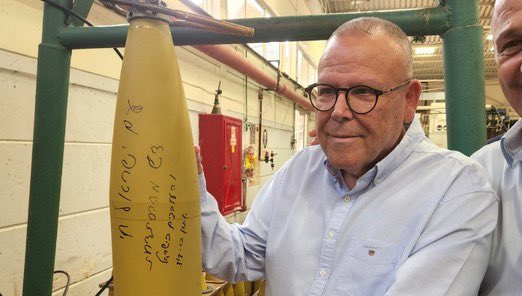
Its Vice President comes from the Zionist Histadrut, a so-called “union” whose leaders write greetings on bombs sent to Gaza.
Histadrut was the architect of apartheid in the workplace — denying registration to Arab workers while representing only Jewish ones, binding them to Zionist colonialism. Labour Aristocracy was always aligning with the colonialist powers benefiting from the surplus value and resources stolen from the colonized working people. Palestinian and migrant workers, the true proletariat, labor without rights or recognition.
Histadrut is not merely a sellout — it is a pillar of apartheid.
And across the world, similar bureaucrats infest the ITUC, selling out workers for positions and grants.
Those who still justify their unions’ membership in ITUC do a disservice to their members and to class struggle itself.
There is no neutrality in war — the war against the working class never stopped. It only intensifies.
European Union Leaderships and War Collaboration
Is it by accident that the European Trade Union Confederation (ETUC) echoes the same war rhetoric?
They declare:
“Financing the defense sector cannot be effective without a clear and coherent EU-wide defense policy”.
What does this mean?
They use slogans about peace while rationalizing the rearmament of their own ruling classes under the banner of “European unity” to the working people. They bring death and destruction to the global working class with union lingo. They call for “dialogue” and “reform” while the working class is bled dry.
Their “strategy” is not to resist imperialism but to manage it — a dead-end path of betrayal.
Why We Expose Them
We expose ITUC and ETUC not out of rivalry, but because clarity is a revolutionary duty.
The working class must know who its friends and enemies are. We need to barricade our positions and fight in the war that is being held against the working class.
Only then can we build true internationalist solidarity.
The Role of FES — A Wolf in Sheep’s Clothing
What is the Friedrich Ebert Stiftung (FES)?
Why is it everywhere — in Africa, Latin America, and Asia. Do the German socialdemocrats have done so much for a strong trade union movement in Germany that they care so much to export their knowledge and experience to other countries to uplift the working class? That would be a joke. Hardly.
FES is the long arm of German and EU imperialism, a “soft power” colonial tool.
And the name it carries — Friedrich Ebert, the first President of the German Reich — is no coincidence.
Ebert, the so-called “trade unionist,” was a traitor to the working class, the moral instigator of the assassinations of Rosa Luxemburg and Karl Liebknecht.
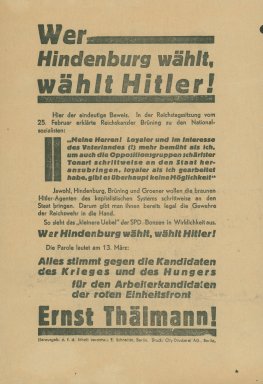
Without the betrayal of Ebert and the Social Democrats (SPD), Hitler’s rise was facilitated.
When the Communist Party of Germany, led by the metalworker Ernst Thälmann, stood firm against fascism, it was the SPD that opened the road for Hitler — and many of its members later perished in the very war they enabled.
History repeats.
The tools are updated — the crimes are the same.
The Ideological War Against the Working Class
Beyond wars, coups, and embargoes, the bourgeoisie wages a deeper, continuous war — an ideological war.
They know their true enemy is not a foreign nation, but the working class itself — the collective producer, the heart of all social wealth.
To neutralize this power, they deploy:
• NGOs, “friendly” foundations, and social democrat institutions like the FES.
• Media, education, and culture, reshaping history to erase revolutionary memory.
• Money and influence to infiltrate unions and corrupt leaders.
They use familiar faces and false solidarity to divide and confuse the workers.
They want to occupy not only the factories and streets but also the minds and hearts of the people.
It is colonialism of consciousness.
The Rising Anger of the Working Class
All over the world, the anger of the working class is growing.
This anger can explode in spontaneous revolts, unorganized riots, or far-right manipulations — or it can transform into conscious, organized class struggle.
Our duty is to give direction and organization to this rage, to turn despair into revolutionary purpose.
Examples of Working-Class Militancy
United States
The leadership of the AFL-CIO has picked sides with the imperialists— offering only lawsuits, electoral campaigns, and applause for bourgeois politicians.
But beneath this bureaucratic surface, workers are awakening.
They are forming community self-defense networks, resisting ICE raids, and rebuilding militant unity.
India
Our comrades have shown the world what organized labor can achieve:
250 million workers participated in the world’s largest strike this year.
The unity of CITU, AITUC, and other confederations has become a living symbol of class-oriented trade unionism.
 Italy
Italy
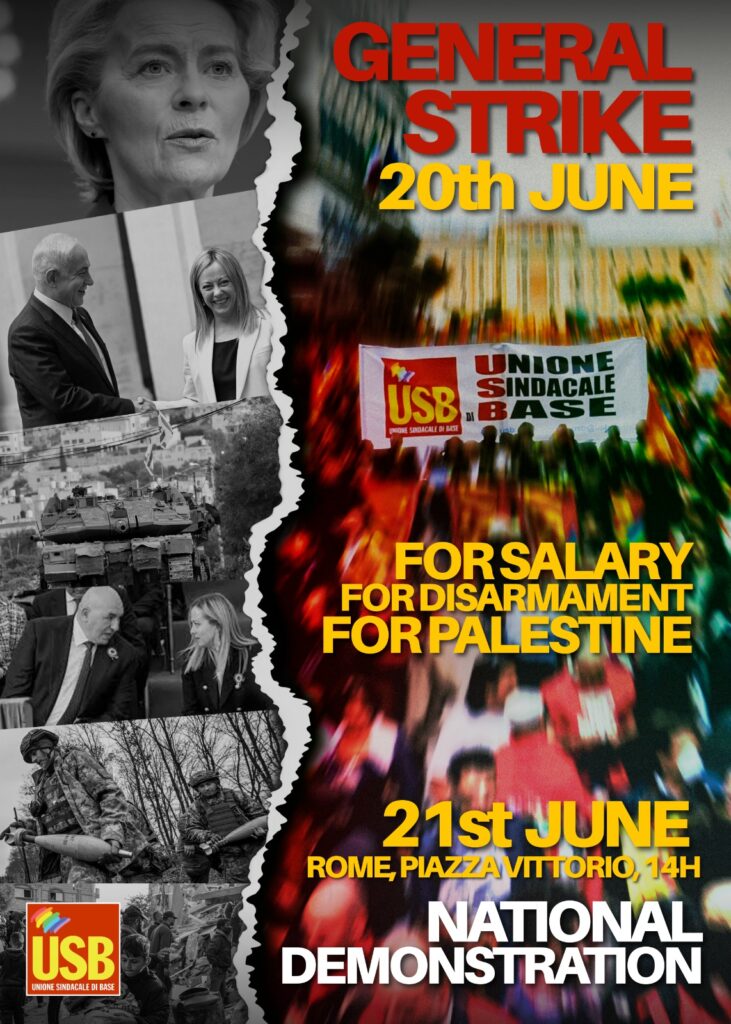
Our comrades in USB have unmasked the corruption of the reformist CGIL leadership.
They have organized massive grassroots struggles — shutting down ports, blocking arms shipments, and striking in solidarity with Palestine.
Millions filled the streets, demanding disarmament, end of any relation to Israel and an economy for the people’s interests.
Years of patient organizing bore fruit: a workers’ movement that opens the eyes of the class to its true power.
Our action plan and demands need to open the eyes of the workers to what is are their contemporary needs. That shows them that the technological and scientific advances, the resources and the growth should be used by the people for the people, to reduce the work hours and not increase them. To provide them free healthcare and free contemporary education. Significant increase of salaries against the escalating living cost, safe workplaces from occupational diseases and capitalist crimes masked as accidents, pension and social services for dignified life. Protective strategies against natural phenomena, floods, earthquakes, fires etc.
France
Comrades of the CGT are rebuilding a class front inside their confederation.
At the 80th Anniversary of the WFTU in Paris, held under the slogan “WFTU Anticapitalist and Anti-Imperialist”, Cde Mavrikos declared:
“To know where we are going, we must know where we come from. We go far to the abolition of exploitation. We stand in front of the global working class with respect, with responsibility, and with pride. The world bourgeoisie, monopolies, multinationals, and imperialists were always against us—with attacks, lies, and attempts to divide us. They paid and still pay anti-worker groups inside the international union movement. Paid bureaucrats, corrupt elites, barking like wild dogs. The dogs bark, but the caravan moves on. The Red Caravan moves on!”
Class Collaboration vs. Class Struggle
There have always been two lines in the trade union movement:
| Line | Essence |
|---|---|
| Class Collaboration | Reformism, corruption, ideological disarmament of the workers. |
| Class Struggle | Independence, militancy, revolutionary education, and respect for the working class. |
We must choose.
Either we stand with the bourgeoisie and their agents, or we stand with the working class and their cause.
There is no middle ground.
In every country there are groups of trade unionists smaller or bigger, who are fighting to change the correlation of forces in favor of the class-oriented trade union movement. Struggles unfold and will unfold inevitably, either in company or industry based, in regional or national level. Our duty is to give all our powers for the direction of these struggles for the orientation of these struggles, for the road ahead their opening. Can we say for example, as reformist unions say, yes to change the production from cars to tanks and propagate for the interest of the bosses that this is good for the workers to save their jobs, the economy and the country? Or do we see further from our nose that they are preparing as for cannon fodder. Don’t we need to fight together with our colleagues against this future, against imperialist wars, for the change of the social system that exploits and kills us to profit from the destruction and profit from the reconstruction as they want to do now in Ukraine and Gaza?
The Creation of the International Workers Institute (IWI)
Under the guidance of Comrade George Mavrikos and the support of an Executive Committee with cadres like comrade Zola, the IWI was founded to tip the scale in favor of the emancipation of the working class.
Cde Mavrikos, after 22 years serving the WFTU as Vice President, General Secretary, and now Honorary President, continues the struggle as President of the Institute.
He has armed us with a powerful weapon:
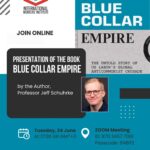
a book on The History of the Trade Union Movement and the Issues of Strategy and Tactics.
It documents the moral and ideological superiority of class-oriented trade unionism over the corrupt “yellow” unions.
This book is not academic — it is a manual for struggle, a shield and a sword in the ideological war of our time.
Reclaiming Our Revolutionary Memory
The bourgeoisie tries to rewrite history — in schools, universities, films, and even in algorithms — erasing our heroes and our victories.
But we will not forget.
We study our past to prepare for the future:
Our books, our archives, our experiences belong not only to the current generation but to all who will continue the struggle.
For example, Shoulder to Shoulder: WFTU and the South African Worker documents how international solidarity helped defeat apartheid — not with slogans, but with material aid, strikes, and action.
As Comrade Eric Mtsali said:
“WFTU did not make slogans only — they materially supported us.”
The same lessons guide our solidarity with Palestine and with the people of Swaziland, who fight for liberation, democracy, and workers’ power.
Our Responsibility as Trade Unionists
The history of the WFTU, like every national movement, is not linear.
It is a battle of ideas, with mistakes and pressures along the way.
Our duty is to:
• Protect the ideological direction of the movement,
• Be patient when necessary, bold when required,
• Be ruthless against capitalism,
• Stay humble and close to the people,
• And always be ready to lead in action by example.
As we speak, Cde Mavrikos is on tour in Latin America, after presentations across India, Italy, and Spain.
In November, a major symposium will be held in Greece:
“The Contemporary Characteristics of the Working Class in Our Era.”
Its outcomes will become a new book — a collective effort to sharpen our analysis and our tools for the coming struggles.
Comrades, we may feel progress is slow — but every strike, every rally, every leaflet adds fuel to the fire of revolution. We carry wood, for the fires to come.
When that fire erupts, it will be unstoppable.
A World on the Brink
Dear comrades, brothers and sisters — the world stands closer to a third world war than at any time since 1945.
But this realization is not for despair — it is for clarity.
We must understand our historic tasks.
As Lenin said in 1916:
“The socialist revolution may break out not only as a result of a proletarian movement in all the developed countries simultaneously but also as a result of an uprising of some colonial or oppressed peoples against imperialism — a revolt that can draw the proletariat of the most developed countries into the struggle and cause the collapse of capitalism in those countries as well.”
— Lenin, The Socialist Revolution and the Right of Nations to Self-Determination (1916)
Africa at the Crossroads
From the mines of Congo to the ports of Durban and the sugarcane fields of Swaziland, Africa’s workers stand at the crossroads of a new imperialist scramble — for cobalt, lithium, gold, and control.
Debt and militarization repeat the colonial pattern.
Our task is to make Pan-Africanism a class project, not an elite one.
Militant unions — dockers refusing to load weapons for Israel, French rail workers striking against war budgets, South African comrades rebuilding class independence — show us the path forward.
This is the seed of a new internationalism.
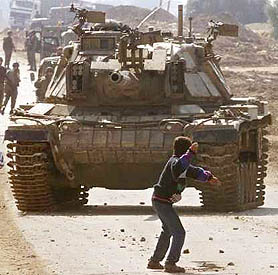
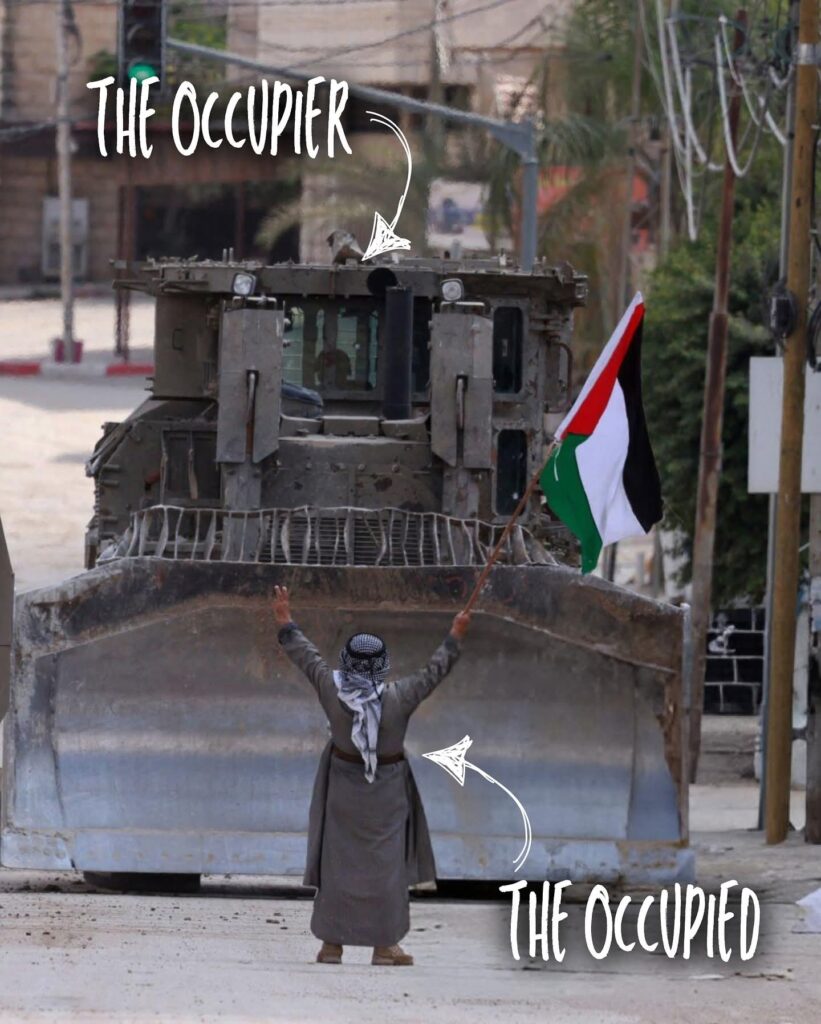
For Peace, People’s Liberation and Socialism
We will not be slaves.
We will not be cannon fodder.
We will not be divided by nationalism, racism, or artificial borders.
We build a movement against imperialist war and for disarmament, while preparing for our historic national duty — the overthrow of the capitalist class in our own countries.
This is our greatest contribution to the international workers’ movement.
The so-called “patriots”, the racist nationalist demagogs, who sell their countries to imperialists have no homeland and no religion.
They sell counterfeit patriotism and open the gates of hell.
The true homeland will be defended by the people — led by the working class.
Power will not be gifted; it must be seized from the bourgeoisie and given to the people, safeguarded by the organized proletariat.
We will crush the plutocracy beneath our feet so that the people become masters of their own land.
We will build a society based on respect, fraternity, and solidarity — with production liberated from market anarchy, organized through socialized planning, serving human need.
We will heal the sick, educate the children, liberate women, and create culture for the people.
And to those who hesitate or compromise, we pose the only question that matters:
Either with Capital, or with the Workers.
Closing Remarks
I thank PUDEMO and the NUM for this invitation.
Your initiative for a Labour School stands at the heart of the mission of the International Workers Institute.
The modern capitalist system — tied to AI, data monopolies, and surveillance — uses algorithms as weapons of class domination.
Platforms like Amazon, Google, Microsoft, Palantir, Meta shape consciousness and suppress the working class voice.
We must build our own channels of communication and solidarity, independent from imperial control.
The struggle of Swaziland’s workers is our struggle.
We must:
• End international support for the Swazi ruling elite. An end to the Monarchy.
• Demand education and healthcare for the Swazi people.
• Raise the flag of Swaziland’s liberation across the world.
And when the ruling class tells us to choose between submission and death — we will answer, as always:
We choose victory. We will win.